All native trees matter, but some matter more than most. Keystone species support disproportionately more wildlife than other species. When it comes to trees, their degree of influence on food webs, structure, and ecosystem function is important in almost every terrestrial ecosystem. Furthermore, because trees live for decades or centuries, they become long-term anchors for biodiversity.
To explore that, we spoke with Basil Camu, an arborist, author of From Wasteland to Wonder, and co-founder of Leaf & Limb, whose work focuses on helping trees function as living ecosystems in everyday landscapes. His perspective reframes trees not as objects in a yard, but as systems that hold entire communities of life together.
What are keystone trees?
Not all native plants play the same role in an ecosystem. Some species carry a disproportionate share of ecological function. These are known as keystone species.
Camu describes it this way: “A keystone species is one whose presence, or absence, has an outsized effect on everything around it. It has low functional redundancy, meaning if it disappears from its ecosystem there are no other species that can fill that specific niche. Keystone species hold entire ecosystems intact. When they die, so too does the life that relies on them.
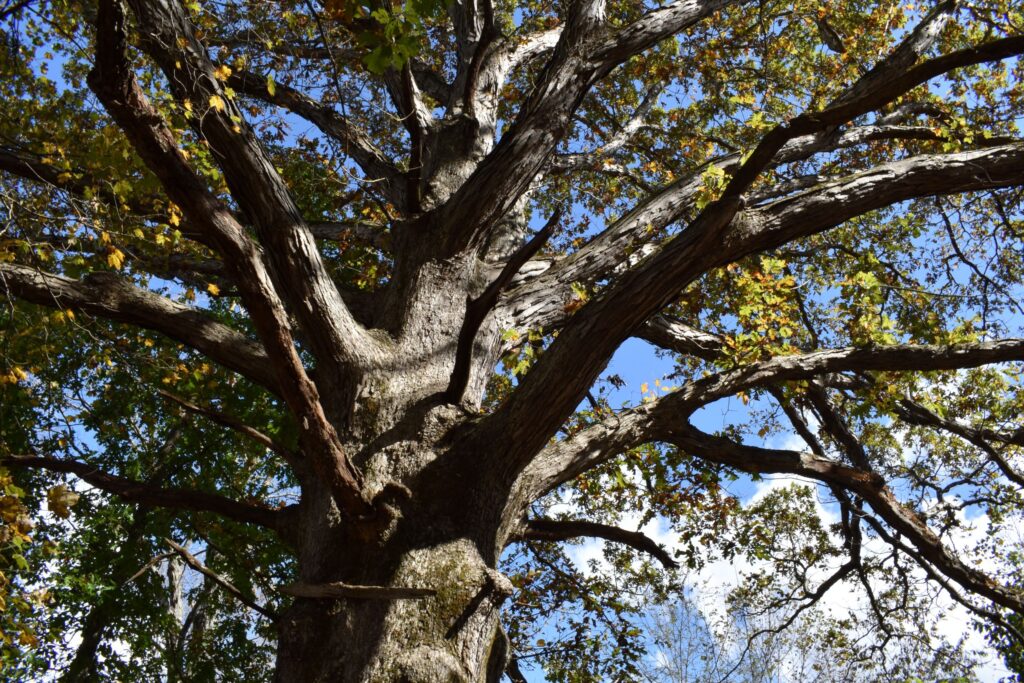
Let’s use the white oak as an example. Their leaves feed around 1,000 different types of caterpillars and various other insects, which in turn feed countless local and migratory birds. Their acorns are full of protein, fat, and carbohydrates, all of which are essential food for over 100 different types of vertebrates. They provide homes for bats, birds, bees, and countless others. Even a single gram of moss on their bark contains 132,000 tardigrades, 150,000 protozoa, 800 rotifers, which are entire micro-ecosystems unto themselves.
In practical terms, it means that one well-chosen native tree in a yard does more ecological work than a dozen ornamentals. It’s not just a tree. It’s an entire city for life.”
What emerges from this is a different way of thinking about planting. A tree is not just a visual element in a landscape. It is a structure that supports entire layers of life, from insects to birds to organisms in the soil and even microscopic communities on its bark.
When you choose a keystone species, you are not just adding a plant. You are rebuilding ecological function.
How to plant a tree that actually functions as habitat
Planting a tree is one thing. Growing one that actually supports life is another.
Much of the advice people receive about tree planting focuses on size, speed, and aesthetics. The result is often a tree that survives, but struggles to function. Camu’s approach shifts that focus toward establishment, soil, and long-term health.
He puts it this way: “I’ll answer this two ways:
If you have not yet planted the tree, plant a bare-root 1 to 3-year-old sapling rather than a large traditional nursery tree. This might sound counterintuitive, but here’s the reality: a sapling establishes during its first growing season with little to no supplemental watering, develops an ideal root system, and will typically outpace a much larger nursery tree over a five-to-ten year horizon. Meanwhile, a large balled-and-burlapped tree arrives with a small fraction of its original root system intact and spends years just repairing that damage. A USDA study found the typical street tree lifespan is 19 to 28 years. An oak in the wild can live over 1,000 years and isn’t even considered mature until it reaches 300.
If the tree is already there and is maturing, improve the soil underneath it. Everything else follows from that.
The sub/urban landscape is a genuinely tough place for a tree to grow. Soil gets stripped, compacted, paved over, and soaked in chemicals. The soil food web, the bacteria, fungi, earthworms, and all the other life that a tree depends on, gets destroyed. A tree trying to grow in that environment is fighting an uphill battle no matter how good the species or how well it was planted.
The good news is that fixing this is easier than most people think. Stop removing the leaf litter. Add arborist wood chips underneath the canopy. If you can, add compost or compost tea. These simple steps feed the soil ecosystem, build organic matter, and restore the conditions the tree evolved to grow in. You don’t need special knowledge or expensive products. You mostly need to stop doing the things that are working against the tree in the first place.
A tree with healthy soil underneath it has exponentially better access to water, nutrients, and the fungal networks it relies on. That translates directly into a healthier, longer-lived tree that functions better as habitat. It is the foundation for everything else.”
What this points to is a shift away from short-term results and toward long-term function. The goal is not just to get a tree into the ground, but to create the conditions where it can grow into something ecologically meaningful.
When does a tree start making an impact?
There’s a common assumption that trees take decades to matter in a landscape. That the real ecological benefit comes much later. Camu challenges that idea:
“It starts immediately. In the same year you plant a native tree, it is already feeding life above and below ground. That is real, meaningful habitat value in year one.
But here is what people often misunderstand: a tree’s ecological value doesn’t just grow, it compounds. Mature trees have 100 times more leaf and root mass than young trees. That means exponentially more leaves to feed insects, branches for birds to nest, bark for moss to colonize, hollows for bats and woodpeckers, dead wood for fungi, and roots supporting entire underground communities. These benefits can only be replaced with one thing, which is time. No amount of money in the world can transform a 10-year-old oak into a 350-year-old oak.
The mistake people make is expecting a tree to ‘arrive’ at some point. It never stops becoming more valuable. Every year is a compounding return.”
The takeaway is not just that trees matter, but that time matters. The sooner a tree is planted and supported, the sooner that compounding begins.
What if you have a small yard?
A small space is often seen as a limitation, especially when thinking about large canopy trees. But scale does not eliminate impact.
Camu puts it simply: “Don’t let a small space become an excuse. A single native tree in a small suburban yard is still an ecological powerhouse. The key is what you do around it.
If space genuinely won’t accommodate a large shade tree, that’s okay too. There are wonderful small to medium native trees, dogwoods, serviceberries, and native cherries for example, that provide real food and shelter for local life while fitting comfortably into tighter spaces. These aren’t consolation prizes. They are valuable members of the native plant community and support species that won’t even touch an oak.
But whatever you plant, think in layers. Most trees in the sub/urban landscape have nothing growing underneath them, just bare mulch, turf, or bare soil. That’s a missed opportunity. Planting smaller trees, shrubs, and flowers under an existing canopy creates understory layers that insects need to complete their life cycles. Many caterpillars feed in the canopy and then drop to attach themselves to smaller plants below, where they transform into butterflies and moths. If those layers don’t exist, those caterpillars die.
So in a small yard: plant the right tree for the space, build layers underneath it, leave the leaves, and stop trying to make it look tidy. You’ll end up with something that outperforms a much larger yard managed the conventional way.”
This reframes the idea of space. It’s not about how much you have, but how well it functions.
What does good tree stewardship look like over time?
Planting a tree is only the beginning. “It starts with proper planting, and hopefully with a very young sapling, not a containerized or balled and burlapped tree.” Camu explains further, “Structural pruning in the early years is one of the two most important things you can do for a tree in the sub/urban landscape. A tree growing without competition, which is most sub/urban trees, develops multiple trunks and long branches crowded together. That’s not a natural environment, and those trees are more likely to split and fail. Structural pruning mimics the competition a tree would experience in the forest and trains it to develop a strong central trunk. I recommend pruning every year for the first 15 years if possible, tapering off from there.
Beyond that, build great soil in the ways described previously. Leave the leaves. Don’t blow away or bag the leaf litter under the tree. That layer is where the soil food web lives, where insects overwinter, where the connections that make a tree function as habitat actually exist. The moment you remove it, you’ve severed those relationships. Add arborist wood chips. Plant understory plants. Add compost if you would like.
Last but not least, be careful about causing damage to the roots, especially those under the canopy. Don’t use heavy equipment to dig, don’t compact that space, and don’t add harmful chemicals and products that kill the life there.
At 20 years, if you’ve done those things, you have something genuinely remarkable that can live for hundreds of years.”
This is long-term thinking. The kind that turns a planted tree into lasting habitat.
From planting trees to growing them
There is one final shift that changes how people relate to trees entirely.
Camu describes it this way: “Most people think about getting trees into the ground. Growing them from seed is a different orientation entirely, and it changes everything.
When you grow a tree from a locally collected seed, you get something you cannot buy at a nursery. That seed carries the genetic adaptations of its parent tree, which spent its whole life figuring out how to thrive in your specific soils, your specific rainfall, and your specific climate.
Growing trees from seed also changes your relationship with the community around you. Volunteers who knew nothing about trees are now happily growing, planting, and tending to native trees in their neighborhoods.
But here is the thing I find most exciting about this model. When someone grows a tree from a seed they collected themselves, something shifts in them. They understand, in a way that no book or lecture can produce, that this little organism is alive and connected to everything around it. That understanding is what changes hearts and minds.”
That shift is what ultimately drives change. Not just in individual landscapes, but in how people see their role within them. This is the opportunity in front of us. Not just to plant trees, but to grow them, care for them, and understand what they make possible.
See more from Basil Camu
Wild Ones Presents
From Wasteland to Wonder
Basil Camu explores practical, evidence based ways to heal suburban and urban landscapes by working with trees, soil, and natural systems, drawing on real world practices from Leaf & Limb and community centered models for restoring life where we live, work, and play.