
Mosquitoes are among the most frustrating challenges faced by individuals seeking to enjoy and steward their outdoor spaces. At the same time, growing awareness of insect declines has raised important questions about the ecological consequences of many common mosquito control practices.
Broad-spectrum insecticide applications can affect non-target insects. For gardeners working to create habitat for native bees, butterflies, fireflies, and other beneficial organisms, the challenge becomes finding mosquito management approaches that are both effective and ecologically responsible.
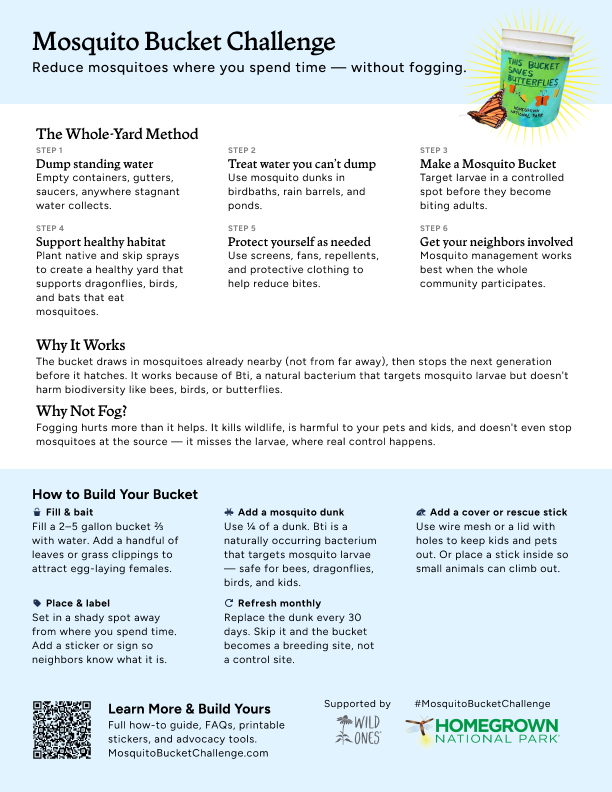
Last year, our partner Homegrown National Park created the Mosquito Bucket Challenge- to promote a simple, low-cost way to reduce mosquitoes where most of them begin: standing water.
A Science-Based Approach to Mosquito Management
One increasingly popular approach to mosquito management is the use of mosquito buckets, a larval control technique that combines an understanding of mosquito behavior with a biological control agent known as Bacillus thuringiensis israelensis (Bti).
Mosquito buckets align closely with the principles of Integrated Pest Management (IPM), an ecologically based approach to pest control that emphasizes prevention, monitoring, and targeted interventions while minimizing impacts on non-target organisms and the broader environment. Rather than relying solely on broad-spectrum insecticide applications, IPM seeks to manage pests through a combination of complementary strategies.
Federal, state, and local public health agencies, including the CDC and EPA, promote integrated mosquito management programs that may include monitoring mosquito populations and disease risk, eliminating standing water where mosquitoes breed, public education, biological controls such as Bti, personal protective measures, and, when necessary, targeted insecticide applications.
Mosquito buckets fit within this framework by targeting mosquitoes during their aquatic larval stage, before they emerge as biting adults. By combining an attractant breeding site with a biological larvicide, mosquito buckets offer homeowners a practical tool that can help reduce mosquito production while minimizing impacts on pollinators, fireflies, and other beneficial insects.
This integrated approach recognizes that no single strategy can eliminate mosquitoes entirely. Instead, effective mosquito management relies on combining multiple practices to achieve meaningful reductions while supporting both public health and ecological stewardship.
Why Mosquito Buckets Work
The effectiveness of mosquito buckets is rooted in two well-established principles of mosquito biology: the tendency of female mosquitoes to seek suitable aquatic habitats for egg laying and the effectiveness and specificity of Bacillus thuringiensis israelensis (Bti) as a biological control agent against mosquito larvae.
There are over 200 species of mosquitoes in North America. Most require standing water to complete their life cycle. Female mosquitoes lay eggs in stagnant water, and the larvae that hatch spend days to weeks feeding on microorganisms and organic matter before transforming into pupae and eventually emerging as adults.
A mosquito bucket takes advantage of this behavior. By providing a small container filled with water and organic matter such as leaves or grass clippings, the bucket becomes attractive to egg-laying mosquitoes. A biological larvicide called Bti is added to the water, preventing larvae from developing into adults. The result is a simple trap that turns a preferred breeding site into a population sink.
What is Bti?
Bacillus thuringiensis israelensis (Bti) is a naturally occurring soil bacterium that has been used for mosquito control for more than 40 years. It is a biological larvicide, meaning it targets mosquitoes during their aquatic larval stage before they emerge as flying adults.
When mosquito larvae feed in the water, they ingest proteins produced by Bti. In the alkaline digestive system of the larvae, these proteins become active and damage the gut lining, causing the larvae to die before completing their development. Because this mode of action depends on the unique physiology of certain fly larvae, Bti is highly selective.
Unlike broad-spectrum insecticides, Bti does not kill adult mosquitoes and has not been shown to harm bees, butterflies, dragonflies, birds, fish, mammals, or other wildlife when used according to label directions. Instead, it specifically targets the larvae of mosquitoes, black flies, and fungus gnats.
Field studies routinely find very high reductions in larval and pupal survival with up to a 98.5% reduction in mosquito pupae after Bti treatment.
How to Build a Mosquito Bucket
Mosquito Bucket Supplies
- Five-gallon bucket
- Water
- Dead leaves, grass clippings, or other organic material
- Mosquito dunk or Bti granules
- Bucket cover or lid

Step 1: Get a bucket
Use any standard bucket; any size will work. However, five-gallon buckets are preferred because they offer a large surface area and optimal volume to attract mosquitoes without drying out in the summer heat. Dark colors tend to be favored by mosquitoes. Often, free buckets can be sourced from local bakeries or restaurants.
Step 2: Decorate
Decorating the bucket is entirely optional but can be a fun way to personalize the project or spark conversations with neighbors. Buckets can be painted with a plastic-bonding primer, followed by acrylic or spray paint, and finished with a clear protective sealer. Waterproof stickers, vinyl decals, or weather-resistant labels are also great options.
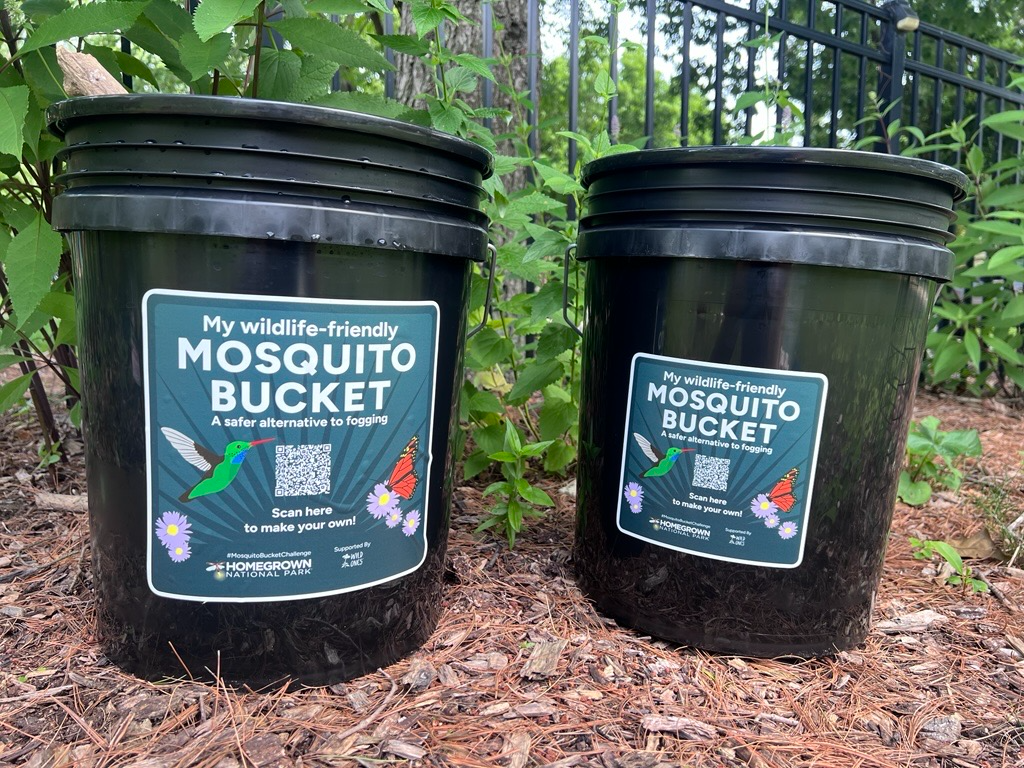
Every purchase supports the educational work of Homegrown National Park and Wild Ones.
Step 3: Add Organic Matter
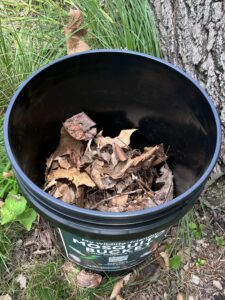
Place a few handfuls of leaves, grass clippings, or other yard debris into the bucket. As the material decomposes, it creates the organic-rich conditions many mosquitoes prefer for egg laying.
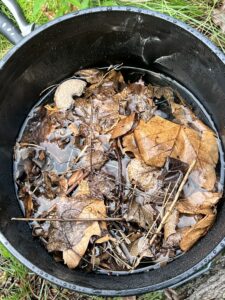
Step 4: Fill with Water and add Bti
Fill the bucket approximately three-quarters full. Hose water is fine; the chlorine will dissipate within a few days. Add a mosquito dunk or the appropriate amount of Bti according to product directions.
Step 5: Cover Your Bucket
While mosquito buckets target mosquito larvae, other insects and small animals may occasionally interact with the water. Covering the bucket with a lid drilled with holes at least 1 cm (3/8 in) in diameter or securing wire mesh over the opening with bungee cords, straps, or a heavy rock helps prevent larger wildlife from entering while still allowing mosquitoes access to lay eggs. Hydroponic Plant Pots are another great solution because they cover the bucket fully while still allowing mosquitoes to enter.
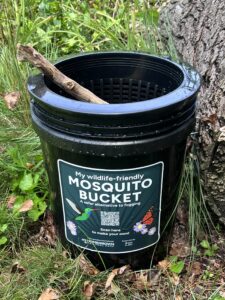
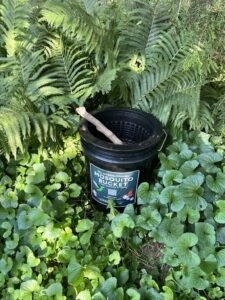
In areas where pets and small children are not a concern, an uncovered bucket may also be used. In this case, adding a sturdy stick, piece of bark, or other textured material that extends above the waterline provides an escape route for small animals that may accidentally enter the bucket.
Step 6: Place the Bucket
Place the bucket in a cool, shaded location where mosquitoes naturally rest. Adult mosquitoes spend the heat of the day in humid, protected areas such as beneath shrubs, around dense vegetation, beside woodpiles, under decks, along fence lines, or near brush piles. Positioning the bucket in these low-traffic areas makes it more likely to be discovered by egg-laying females while keeping it out of the way of everyday activities.
Step 7: Maintain the Bucket
Add fresh Bti dunks according to label instructions, typically every 30 days. Check water levels periodically during hot weather. Mosquitoes like stagnant, dirty water because the larvae feed on decaying organic matter and bacteria. You won’t need to replace the bucket water often, but if you want to change the water, it’s safe to dump it into a garden bed or lawn.
See Homegrown National Park’s quick setup guide: https://www.youtube.com/shorts/6l9ZddXxad4
What Mosquito Buckets Can and Cannot Do
You won’t see an immediate decrease in the number of biting mosquitoes in your yard. Starting early in the mosquito season, before populations build, will improve results. Larger areas will require multiple buckets. Mosquito buckets are most effective when combined with other mosquito management practices:
- Regularly remove unnecessary standing water from containers, toys, and gutters
- Maintain bird baths and water features
- Encourage natural predators such as dragonflies, birds, bats, and amphibians with native plants
- Use fans, protective clothing, and personal repellents when mosquito activity is high
- Share a bucket or two with your neighbors
If mosquitoes are not already a problem in your area, you likely don’t need a mosquito bucket. Female mosquitoes locate standing water using a combination of visual and chemical cues to lay their eggs. The Mosquito Bucket Challenge is intended to intercept egg-laying by local mosquitoes already present in your neighborhood, not to attract mosquitoes to areas where they are absent.
Mosquito buckets are not a silver bullet, but they can help reduce local mosquito populations while avoiding the ecological impacts associated with broad-spectrum spraying.
A Small Action with a Big Impact
Healthy landscapes depend on insects. The challenge is reducing pests without harming the many beneficial species that share our yards.
Mosquito buckets offer one practical way to strike that balance. By targeting mosquitoes at their source, homeowners can take action against a summertime nuisance while helping protect pollinators, fireflies, and other wildlife.
To learn more about the Mosquito Bucket Challenge, visit Homegrown National Park and find additional resources, FAQs, and ways to participate in the Mosquito Bucket Challenge.
References
Derua YA, Kahindi SC, Mosha FW, Kweka EJ, Atieli HE, Wang X, Zhou G, Lee MC, Githeko AK, Yan G. Microbial larvicides for mosquito control: Impact of long lasting formulations of Bacillus thuringiensis var. israelensis and Bacillus sphaericus on non-target organisms in western Kenya highlands. Ecol Evol. 2018 Jul 6;8(15):7563-7573. doi: 10.1002/ece3.4250.
National Pesticide Information Center, 2000. Bacillus thuringiensis technical fact sheet.
Bahrami R, Quaranta S, Perdomo HD, Bonizzoni M, Khorramnejad A. Carry-over effects of Bacillus thuringiensis on tolerant Aedes albopictus mosquitoes. Parasite Vectors. 2024 Nov 7;17(1):456. doi: 10.1186/s13071-024-06556-3.
Affiliate Disclosure: Whenever possible, we encourage shopping with local nurseries and small businesses. But we recognize online shopping from retailers like Amazon may be the only or most convenient option for some purchases. We may earn a commission at no extra cost to you if you make a purchase through one of our links. This helps support our mission but does not influence our reviews or recommendations.