
One of my favorite native shrubs for winter interest in the garden or landscape is Ilex verticillata, commonly known as winterberry. This deciduous holly loses its leaves in the fall, unlike many other hollies that retain their foliage through winter. The absence of leaves makes the bright red, berry-like drupes that persist all winter especially striking and gives the shrub its common name.
This is an excerpt from the Wild Ones Journal
Current members can log in to read the latest issue or check out the Journal Archives.
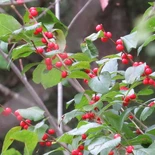
Common Winterberry(Ilex verticillata)
Winterberry is most often found growing naturally in wet areas such as stream banks, ponds, or lakes, in full sun to partial shade and rich, organic soil. It is adaptable to garden settings as long as it has consistent moisture and low soil pH. Growing winterberry in higher pH soils can lead to chlorosis, a condition in which leaves produce insufficient chlorophyll. As chlorophyll gives leaves their green color, chlorotic leaves appear pale yellow or yellow white.
Winterberry may also be susceptible to leaf spot and powdery mildew, although these are generally not significant issues. Due to its preference for wet soils, it is a good choice for rain gardens.
Winterberry is generally dioecious, meaning male and female flowers occur on separate plants. Both male and female plants are needed for fruit formation, although one male plant in the general area is sufficient for multiple female plants. Occasionally, perfect flowers containing both male and female parts appear alongside unisexual flowers on the same plant. Flowers are white, inconspicuous, and appear from June through July.
Male flowers grow in clusters of three to ten, while female flowers grow singly or in small groups of two or three. Although male and female flowers look similar, female flowers usually have more petals, typically six to eight, and a single central ovary. Male flowers generally have four to six petals and four to six stamens. When pollinated, female flowers develop into drupes that start green and ripen to bright red by fall. Botanically, a drupe is a fruit with a single seed or stone, such as a peach.
Flowers appear on new growth, so any pruning should be done in late winter or early spring before new shoots emerge.
The leaves are alternately arranged and elliptical in shape, generally twice as long as they are wide, with serrated edges. Leaves are somewhat flat at the base and pointed at the tip. They range from medium to dark green, are slightly shiny on the upper surface, and lightly pubescent on the lower surface. Fall color is pale green to yellow, occasionally with purple tinges.
Winterberry typically grows six to ten feet tall or taller, with a similar spread. It often spreads by suckers, forming clumps or thickets. These suckers can be pruned back if spreading is undesirable. The bark is dark gray to brown and smooth, with white lenticels developing on older branches.
Winterberry is native to the eastern and central United States and eastern Canada. Its range extends from Ontario to Louisiana and across the central United States to the East Coast. It appears more sporadically in southern states, with more recorded occurrences from Virginia northward.
Another species of deciduous holly, Ilex decidua, is more common in southern regions. Winterberry fruits are eaten by a variety of songbirds and small mammals. Because the berries persist throughout winter, they provide an important seasonal food source. Winterberry is also reported to be a host plant for Henry’s elfin butterfly, which is found mainly in the north, the Appalachian region, and along the Atlantic coast. The leaves support larvae of several moths and flies and are occasionally browsed by white tailed deer, though they are not a preferred food source. The dense, clumping growth habit provides valuable cover and nesting sites for birds and small mammals.
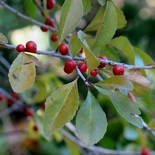
Possumhaw(Ilex decidua)
Like other hollies, winterberry is somewhat toxic to humans, with sensitivity varying by age, weight, health, and individual susceptibility. Toxicity can also vary by season, plant part, and stage of growth. Despite this, winterberry has been used medicinally, including use of the bark as an astringent or antiseptic, the berries as a cathartic, and the leaves for tea. Due to toxicity concerns, these uses should not be attempted without thorough research and guidance.
Propagation from seed can be difficult, as seeds must be scarified after removing the outer flesh and cold stratified at least twice. Propagation from cuttings taken in early spring is typically more successful.