
Is there a plant that just makes you want to smile? Sunflowers, with their bobbing heads and expressive blossoms that follow the path of sun, are a joy to have in the garden and an important food source for a myriad of creatures.
When most people picture a sunflower, they think of the modern cultivated sunflower (Helianthus annuus), the tall annual grown in fields for seeds and oil. While H. annuus is native to North America, the plant we know today has been shaped by thousands of years of human selection. Archaeological evidence suggests that Indigenous peoples in the Mississippi and Ohio River valleys domesticated wild sunflowers about 3,000–4,000 years ago. Over generations, they selected for larger seeds, increasing seed size by more than 1,000 percent (Yarnell 1978). Sunflowers held cultural importance not just as food, but also as a source of oil, medicine, and dyes, and they spread across the continent through Indigenous trade networks long before Europeans arrived. Later, European and Russian breeding further transformed the plant into the giant, uniform-headed crop familiar today.
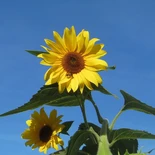
Common Sunflower(Helianthus annuus)
Helianthus comes from the Greek words helios meaning sun and anthos meaning flower
In contrast, wild perennial sunflowers tell a different story. These species vary widely in height, bloom time, and habitat, and they play a critical role in supporting pollinators, birds, and other wildlife. Their diversity and ecological value make them an essential addition to native gardens.
Most native Helianthus species are considered keystone plants, which are plants that support a disproportionately large percentage of food webs. Helianthus produces nectar and pollen that attract and sustain pollinators, including long-tongued bees, short-tongued bees, beneficial wasps, and beetles. Helianthus is also an important host plant for 69 moths and butterfly species, including the silvery checkerspot (Chlosyne nycteis) and gorgone checkerspot (Chlosyne gorgone), a butterfly that is restricted to high-quality prairie dry remnants. By attracting butterflies and associated caterpillars, it offers a food source for many species of birds. Beyond insects, sunflowers produce nutritious seeds eaten by finches, sparrows, and other songbirds, and their dense summer foliage provides shelter for wildlife. Because of their height and structure, sunflower stalks also act as perches and hunting platforms for predatory insects and even small birds.
At the end of the season, sunflowers look a bit worse for wear with brown and tattered seed heads, petals, and foliage but, but this stage is just as important as their summer bloom. Their seed heads feed flocks of migrating goldfinches, sparrows, chickadees, and juncos well into winter, and many overwintering insects shelter inside the hollow stems. Native bees, such as small carpenter bees (Ceratina spp.), use the pithy stalks to create nesting chambers, while predatory insects overwinter as eggs or pupae tucked inside. For this reason, it’s best to leave sunflower stalks standing through the cold months, or trim them back only to about 12–18 inches to support spring emergence.
In the garden, most native sunflowers thrive in full to partial sun. Many spread by rhizomes, so they are best suited to larger plantings or meadow-style gardens, though clumps can be kept in check by dividing every 3-4 years. There is evidence that several species, especially H. annuus, produce phenolic acids and terpenes from foots and decomposing leaves that inhibit the germination of surrounding species. In natural environments, allelopathic agents reduce competition, but in your home garden, it may limit the success of some species. Be sure to research the species you wish to plant and mix them with other tough prairie plants like grasses and goldenrod.
Sunflower seeds germinate after a period of cold, moist stratification. If you have a winter season, you can sow seeds outdoors in fall to allow natural stratification to occur. Or you can visit a native plant nursery to find the Helianthus perfect for your location.
There are ~70 native perennial sunflower species in North America, but many are too localized or too aggressive for general garden recommendations. The following 8 native sunflowers were chosen because together they represent a wide spectrum of habitats, heights, and bloom times. Sunflowers can find a place in almost any landscape. Can you find a space for one in yours?
[Click the plant profiles on the left to see more info, including range maps]
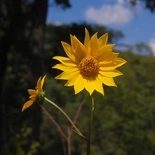
Fewleaf Sunflower(Helianthus occidentalis)
Helianthus occidentalis – Western Sunflower
Sun | Blooms: July–September | Height: 3 ft | Soil: Medium, Medium-Dry, Dry
Western Sunflower has 1–2-inch diameter flowers on top of leafless stalks. The shortest of our native sunflowers, H. occidentalis prefers to grow in drier soils where it can receive full to partial sun. Does well in sandy soils and is generally found in upland prairies.
Range: Widespread across Midwestern and Great Lakes prairies. USDA Zones: 3-9
Fun Fact: Because the leaves are clustered at the base, prairie ecologists sometimes call it the “naked-stemmed sunflower.”
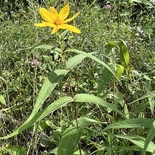
Woodland Sunflower(Helianthus divaricatus)
Helianthus divaricatus – Woodland Sunflower
Sun to Part Shade | Blooms: July–September | Height: ~4 ft | Soil: Medium–Dry, Dry
Woodland Sunflower has 2-inch-wide flowers with bright yellow petals and slightly darker yellow center disks atop smooth stems and short-stalked leaves. The species prefers dry, open woodland or savanna and they make a good fresh cut flower. Its tendency to be highly aggressive can be lessened when planted in dry shade.
Range: Common across eastern U.S. forests, savannas, and woodland margins. USDA Zones: 3-9
Fun Fact: Its shallow roots and drought tolerance make it a great choice for containers and rooftop gardens.
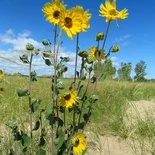
Ashy Sunflower(Helianthus mollis)
Helianthus mollis – Downy Sunflower
Sun to Part Shade| Blooms: July–September | Height: ~6 ft | Soil: Medium, Medium-Dry, Dry
Downy Sunflower has fine, soft, downy hairs that cover the stems and leaves, thus the name. Four-inch single flowers bloom atop the upper stems. Plants tolerate a wide variety of soils, including average, sandy, and poor rocky soils, but require good drainage. The plants will also do well and grow taller in nutrient-rich medium soils. Tolerates some light shade.
Range: Native to the Great Plains and Midwest prairies and rocky glades. USDA Zones: 3-9
Fun Fact: The name “mollis” means soft. A nod to its fuzzy, ash-colored stems and leaves that give it a bluish-gray appearance. The species is also known commonly as ashy sunflower.
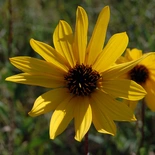
Stiff Sunflower(Helianthus pauciflorus)
Helianthus pauciflorus – Showy Sunflower
Sun | Blooms: July–September | Height: ~5 ft | Soil: Medium, Medium-Dry
Showy Sunflower makes a great addition to any dry soil and full sun garden. One plant produces up to ten flower heads 2-3 inches across. The leaves are typically found on the bottom of the plant.
Range: Widespread across Midwestern and Great Lakes prairies. USDA Zones: 3-7
Fun Fact: This is one of the most widely cultivated species of perennial sunflower.
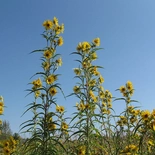
Maximilian Sunflower(Helianthus maximiliani)
Helianthus maximiliani – Maximilian Sunflower
Sun | Blooms: August–September | Height: ~7 ft | Soil: Medium-Wet to Dry
Maximilian Sunflower has 2–3-inch diameter flowers. Stems are clad with rough, narrow, tapered, grayish-green leaves, frequently folded lengthwise. It’s best grown in average, dry to medium, well-drained soils in full sun and is drought-tolerant.
Range: Widespread across the Great Plains prairies. USDA Zones: 3-9
Fun Fact: Its rhizome is edible, historically used by Native American groups as a tuber-like food.
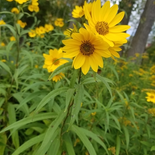
Sawtooth Sunflower(Helianthus grosseserratus)
Helianthus grosseserratus – Sawtooth Sunflower
Sun | Blooms: August–September | Height: 8-12 ft | Soil: Medium-Wet to Dry
Sawtooth Sunflower prefers full sun and moist soil with high organic matter. The flowers are two-to-four inches across on top of reddish-purple stems. Leaves are up to 8 inches long and 2½ inches wide, and coarsely toothed, thus its name. Grows up to 12 feet, but in dense colonies, it may only reach 5 feet.
Range: Found in Great Lakes, northern Great Plains, and parts of the eastern U.S. streambanks and wet meadows. USDA Zones: 3-9
Fun Fact: Its towering stalks often lean toward each other in colonies, creating “sunflower thickets” that serve as shelter for wildlife.
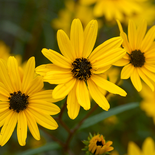
Swamp Sunflower(Helianthus angustifolius)
Helianthus angustifolius – Swamp Sunflower
Sun to Part Shade | Blooms: August–September | Height: ~8 ft | Soil: Wet to Medium
This late-blooming sunflower is an excellent choice for a damp sunny spot in a garden. Its salt tolerance makes it suitable for coastal gardens as well. Prune plants back in June to encourage branching. Unlike other species in its genus, H. angustifolius does not spread aggressively, but forms a gradually growing clump. It is a large perennial that can grow up to 8 feet tall with two-inch flowers.
Range: Native to Southeastern U.S. wetlands and coastal plains. USDA Zones: 6-9
Fun Fact: Swamp sunflower is the latest fall-flowering sunflower and is a valuable late-season nectar and pollen source for pollinator species, including migrating monarch butterflies.
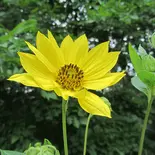
Giant Sunflower(Helianthus giganteus)
Helianthus giganteus – Tall Sunflower
Sun to Part Shade | Blooms: July–October | Height: ~8 ft | Soil: Medium-Wet to Medium
Tall sunflower offers three-inch flower heads atop 8-10 foot purplish stems.
Range: Native across the Northeast and upper Midwest in moist open meadows and prairies. USDA Zones: 3-9
Fun Fact: The purplish-red stems were traditionally used by Indigenous peoples for medicinal purposes, including poultices.
Designing with native sunflowers
Native sunflowers are surprisingly versatile in landscape design. Their tall, upright stems make them excellent background plants in mixed borders or cut-flower beds, where they add late-season color and long stems for arrangements. In larger spaces, they can be grouped with big prairie grasses such as switchgrass (Panicum virgatum) or big bluestem (Andropogon gerardii) to create naturalistic screens or windbreaks that provide both privacy and wildlife cover. When blended with medium-height forbs like blazing star (Liatris spp.), bee balm (Monarda spp.), or goldenrods (Solidago spp.), sunflowers help form layered plantings.
Native sunflowers are an important addition to any landscape and garden. They provide color from mid-summer through autumn when many plants are past their peak. Butterflies and moths feed on native sunflowers throughout their life cycle. Migrating birds appreciate the seeds on their travels. Nonmigratory birds use sunflower seeds as an important winter food source and many insects overwinter in the plant stems.
If you can spare the space, adding sunflowers to your garden improves the overall ecology of your local landscape and provides you, the gardener, with infinite joy and wonder throughout the gardening year.
Thanks to the Prairie Moon Nursery website and the Missouri Botanical Garden website for information about our native sunflowers.