
What does it really take to transform a conventional lawn into a thriving native meadow?
Join Wild Ones and Sara Weaner Cooper for a candid look at her family’s ongoing lawn-to-meadow project. Sara will share the decisions, methods, successes, surprises, and challenges that have shaped the landscape over multiple growing seasons.
About the Webinar
Replacing turfgrass with a native meadow can support biodiversity, strengthen ecological relationships, and create a more dynamic home landscape. But meadow establishment is not an instant process. It requires careful observation, realistic expectations, and management that changes as the plant community develops.
Sara Weaner Cooper, owner and principal of New Directions in the American Landscape, will guide participants through her family’s gradual transition from lawn to meadow, a project featured in The New York Times in 2024 and the BBC in 2025. Rather than presenting one formula for success, she will show how the meadow has evolved through experimentation, ecological processes, changing conditions, and ongoing learning.
Participants will gain practical insights into site preparation, planting, weed management, plant competition, and long-term maintenance. Sara will also discuss how expectations for a meadow’s appearance and function may need to change as the landscape develops over time.
Whether you are considering replacing a small section of lawn or converting a larger area, this webinar will offer a realistic look at what meadow-making involves.
What You’ll Learn
Participants will learn how to:
- Use observation and adaptive management to guide the process
- Evaluate whether a meadow is appropriate for a particular site
- Prepare an area of turfgrass for meadow establishment
- Consider different planting and establishment methods
- Respond to weeds and competition as the meadow develops
- Understand how native plant communities change over time
- Set realistic expectations for appearance and maintenance
Presented in Partnership
This webinar is presented in collaboration with New Directions in the American Landscape (https://www.ndal.org/), an educational organization advancing ecologically informed approaches to landscape design and stewardship.
Register
From Lawn to Meadow
Speaker: Sara Weaner Cooper
Date: Wednesday, September 16, 2026
Time: 7 p.m. Eastern | 6 p.m. Central | 5 p.m. Mountain | 4 p.m. Pacific
Location: Online, join live to participate in the chat. A recording link will be shared after the premiere.
About the Speaker
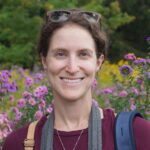
Sara Weaner Cooper, New Directions in the American Landscape (NDAL)‘s owner & principal, began her role with NDAL in 2018 as educational program coordinator. She holds a M.A. in anthropology and education from Teachers College, Columbia University, and a B.A. in anthropology and education from Bryn Mawr College. One of her passions and long-term goals is to work with schools on eco-cultural land stewardship curricula. Her and her husband Evan Cooper’s home landscape was featured in a BBC article in 2025 and The New York Times article by Margaret Roach in 2024, which illustrates an experimental yet highly successful organic transition from lawn to native meadow. Sara has presented about this transition for the Ecological Landscape Alliance’s Annual Conference, Grow Native MA, and the Southern Adirondack Audubon Society. In 2024 NDAL received the American Horticultural Society (AHS) Award for Horticultural Innovation, which recognizes an individual/organization “whose innovations have made the field of horticulture more sustainable and accessible to all.”
About Science at Home
Research-backed actions for healthier home landscapes.
Wild Ones’ Science at Home series brings together national experts to show how conservation science can guide practical native landscaping choices that benefit wildlife, people, and the planet.
Native plants are the foundation. By understanding the relationships among plants, wildlife, soil, water, and ecological processes, we can create landscapes that do more.
Wild Ones connects people and native plants for a healthy planet through education, advocacy, and collaborative action.