
Looking to add color to your native plant garden while supporting pollinators? Blue-flowering native plants are a striking choice that provide essential food sources from spring through fall. Whether you’re planting in sun or shade, dry or moist soil, there’s a native blue bloom for every garden.
Blue Is Always a Good Idea
No matter the primary color scheme I choose for my garden beds, I always include blue flowers to add coolness to a sunny border and depth to a shady garden. Blue-flowering native plants are also an important food source for pollinators from early spring through autumn. I hope one (or all) of the following blue-flowering plants can find a place in your garden.
Early Spring (April-May)
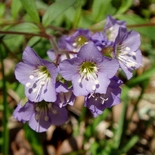
Jacob's Ladder(Polemonium reptans)
Polemonium reptans – Jacob’s ladder
Shade | Blooms: April–May | Highly attractive to early native bees
Benefits: Provides early nectar and pollen to bumble bees, carpenter bees, cuckoo bees, mason bees and other solitary bees, flies, moths, and butterflies
Jacob’s Ladder is a woodland plant that prefers rich soil and will do well planted on the north-side of the house. Jacob’s Ladder self-seeds so you may end up with a nice clump in no time. The small blue flowers attract early-season pollinators. The leaves of Jacob’s Ladder stay green all summer.
Fun Fact: Its name comes from the ladder-like arrangement of leaflets along the stem.
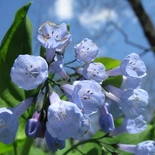
Virginia Bluebells(Mertensia virginica)
Mertensia virginica – Virginia bluebells
Shade | Blooms: April–May | Attracts bumblebee queens, butterflies, and moths
Benefits: Attracts early-season pollinators, female Bumblebees, the Giant Bee Fly, butterflies, skippers, and Sphinx moths
Virginia Bluebells enjoy rich soil that retains moisture. The flowers start off pink and gradually become light blue as they mature. When the soil starts warming up, the leaves of Virginia die back and the plant goes dormant. The plants self-seed and can form a large colony in the spring shade garden. Ferns are good companion plants since they can fill in the space left from dormant Virginia Bluebells.
Fun Fact: The tubular flowers are especially favored by long-tongued pollinators like bumblebee queens.
Late Spring (May-June)
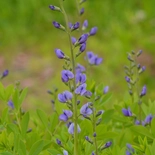
Blue Wild Indigo(Baptisia australis)
Baptisia australis – Blue wild indigo
Full Sun | Blooms: May–June | Attracts bumble bees and butterflies
Benefits: Nectar-rich for large native bees; host plant for duskywing, frosted elfin, and hoary edge butterflies
Blue Wild Indigo provides deep blue flowers in spring and matures to a shrubby form with a height and spread of four feet, so the plant needs quite a bit of room. After flowering, the plant creates seed pods that turn black when ripe and seeds rattle around inside the pods. The dried stems with seed pods are nice additions to dried floral arrangements.
Fun Fact: Crushed stems oxidize into a slate-blue sap—early settlers used it as a dye substitute.
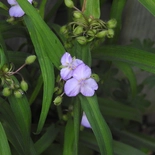
Ohio Spiderwort(Tradescantia ohiensis)
Tradescantia ohiensis – Ohio spiderwort
Full Sun | Blooms: May–July | Attracts native bees, especially bumble bees
Benefits: Besides bees, it attracts beetles, butterflies, flies, and skippers.
Ohio Spiderwort has blue-green grass-like foliage and the bright blue flowers bloom in the morning sun and close to avoid mid-day heat. Does well in sandy soil. Each bloom opens up for only one day. The plants self-seed and can be aggressive, so plant where it can spread or cut it back after blooming to manage it.
Fun Fact: Flowers and stems can be eaten raw, while the leaves can be cooked. Leaves of the plant are mucilaginous and can be used to soothe insect bites in a similar way to aloe vera.
Summer (June–August)
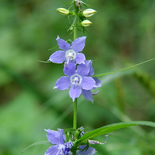
American Bellflower(Campanulastrum americanum)
Campanula americana – Tall bellflower
Partial Shade | Blooms: June–August | Attracts hummingbirds
Benefits: Nectar suited for hummingbirds and long-tongued bees
Tall Bellflower is a self-sowing biennial plant. During the first year, it produces heart-shaped leaves. The second year, a tall stem covered in bright blue blooms arises from the base of deep green foliage. The biennial plants will die after their second year, but their strong self-seeding gives them a perennial presence in the garden. Best grown in rich, moist, well-drained soils in part shade. Deadhead spent flowers to encourage additional bloom.
Fun Fact: It’s the only member of the Campanula genus that has star-shaped flowers, not the typical bell-shaped flowers you’d expect from its name.
Late Summer to Fall (July–October)
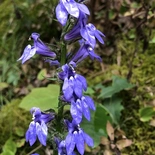
Great Blue Lobelia(Lobelia siphilitica)
Lobelia siphilitica – Great blue lobelia
Full Sun to Light Shade | Blooms: July–September | Attracts hummingbirds and bees
Benefits: Excellent late-season nectar source for hummingbirds, butterflies (including monarchs), and bees
Great Blue Lobelia forms spikes covered in deep blue flowers from late summer to early fall. It forms clumps when planted in wet soils in light shade. The blue flowers are a nice contrast to the yellow flowers of late summer.
Fun Fact: Historically, the species name reflects a now-discredited use in treating syphilis.
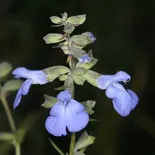
Azure Blue Sage(Salvia azurea)
Salvia azurea – Blue sage
Full Sun | Blooms: July–October | Attracts butterflies, native bees
Benefits: Host plant for the Hermit sphinx moth
Blue Sage has bright blue flowers, and like the Great Blue Lobelia, the flowers stand out against the paler colors of late summer, early autumn flowers. Blue Sage prefers medium to somewhat dry soils and the plants will flop over in overly rich soils. It is good practice to plant Blue Sage with grasses to offer natural support if they do flop. Remove spent flower spikes to encourage extended blooming. Bees and butterflies appreciate this late-season food source. Like typical salvias, blue sage leaves have the typical salvia fragrance, which deters deer and rabbits.
Fun Fact: Its branched root system can double in depth to survive drought, sometimes reaching over 8 feet below ground!
Design Tips
Blue-flowering native plants are useful design tools in the garden. Because blue recedes visually, these blooms can create a sense of depth and space, making small gardens appear larger and more serene. When paired with warm and neutral-tone flowers like yellow Coreopsis, white Symphyotrichum pilosum (Frost aster), or pink Eutrochium (Joe-Pye weed) or Monarda (bee balm). Blue blossoms provide a cool contrast that draws the eye and softens bold palettes. In shady gardens, blue also adds a cooling effect and glows softly in dappled light, especially when paired with silver foliage or ferns.
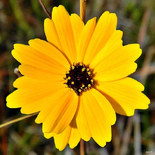
Tickseed(Coreopsis spp.)
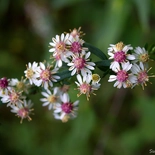
Aster(Symphyotrichum spp.)
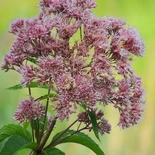
Joe Pye Weed(Eutrochium spp.)
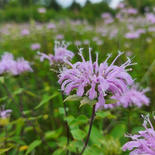
Beebalm(Monarda spp.)
For continuous seasonal interest, use blue flowers as part of a succession planting plan. Start with spring ephemerals like Mertensia virginica (Virginia bluebells) and Polemonium reptans (Jacob’s ladder), then transition to early summer with Baptisia australis (blue wild indigo) and Tradescantia ohiensis (Ohio spiderwort). Finish strong with tall, striking late bloomers like Lobelia siphilitica (great blue lobelia) and Salvia azurea (blue sage). Not only will this ensure a consistent source of nectar and pollen for pollinators, it also gives your garden a harmonious flow from spring through fall.
Conclusion
Blue flowers bring a cooling presence to hot summer borders and glow beautifully in shade gardens. They’re also surprisingly rare, especially in native ecosystems. Blue is rare in flowers because most plants don’t produce true blue pigments. Instead, they create the appearance of blue through a complex mix of pigments, high pH levels, and sometimes microscopic structures that reflect light.
Visit your local native plant nursery to explore what grows best in your region. Thank you to Prairie Moon Nursery, Prairie Nursery, and the Missouri Botanic Garden for plant information. They are great sources to help you find the right native plant for your site.