
At Wild Ones, we’re dedicated to connecting people and native plants. Our Native Plant News blog delivers the latest stories on native plant conservation, scientific discoveries, and habitat restoration from across the nation. This monthly, volunteer-written feature is designed to educate, engage, and inspire action, empowering readers to support biodiversity and promote sustainable landscaping with native flora.
Protect the Pollinators
Virginia: National Pollinator Week is June 16-22, 2025, a recognition designated by Congress to highlight the importance of pollinators in the production of food, as ⅓ of all food and beverage crops and 75% of all flowering plants need pollination to reproduce. Pollinators include native bees, beetles, flies, butterflies and moths, birds, and honeybees. Virginia alone has 458 native bee species, 400 moth species, and 170 species of butterflies.
Unfortunately, pollinator species are declining worldwide due to habitat loss, pesticide use, and climate change. And that’s bad news for humans. “If they aren’t here, we won’t be here,” said Elaine Mills, a Virginia Cooperative Extension Master Gardener and pollinator specialist. To support native bees, Mills says gardeners should leave bare soil for ground-nesting bees and trim hollow stems of old plants in the spring for cavity-nesting bees. She also recommends avoiding invasive species and plant native species, planting a variety of species to attract a great diversity of pollinators, retaining leaf litter and dead trees for insects to overwinter and nest, creating shallow water “puddling areas” for butterflies, and avoiding pesticides and buying untreated plants.
Protect and preserve essential Virginia pollinators during national observance-RocktownNow.com
Be a Habitat Hero
Michigan: Recent studies have shown declines in bird and insect populations for a variety of reasons but habitat loss is a common culprit. Grand Rapids’ John Ball Zoo is hoping to reverse that trend by creating more and better habitats with its Habitat Hero program.
Habitat Hero is a community science program with a goal to create high-quality urban and suburban native habitat to support native pollinators. Since the program started, Habitat Hero has given away 5,900 plants and 3,200 seed packets and has engaged 2,600 community members in the importance of pollinators. Participants in the program receive up to 4 native plants and access to the newsletter that has educational information about pollinators and gardening tips.
Local action isn’t enough. Organizers hope that Habitat Hero will be replicated across the country at other American Zoo Association institutions and are piloting an expansion of the program in Delaware, Georgia, and Nebraska. Habitat Hero also supports habitat goals laid out by programs SAFE North American Monarch and SAFE North American Songbird so partnership and collaboration with other organizations is also possible.
Why We Need Habitat Heroes-AZA.org
Creating Memories at the Memory Triangle
Alabama: Through the efforts of citizen volunteers, Mountain Brooks Parks and Recreation department, and the Environmental Sustainability committee, a pollinator garden has been planted at Memory Triangle. Already designated in February 2023 as the first Bee City USA in Alabama, this pollinator garden continues the positive work being done to make Mountain Brook a city that supports native pollinator species. This included planting a native pollinator garden at City Hall, creating educational information about native habitat on the City’s website, hosting education events raising awareness about supporting native pollinators, and forming the Environmental Sustainability committee.
The native habitat meadow created by the City, committee, and volunteers includes 16 native grasses and wildflowers including blackeyed Susan (Rudbeckia hirta), butterfly milkweed (Asclepias tuberosa), gray goldenrod (Solidago nemoralis), Indian blanket (Gaillardia pulchella), and Maryland golden aster (Chrysopsis mariana).
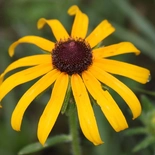
Blackeyed Susan(Rudbeckia hirta)
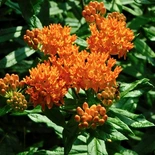
Butterfly Milkweed(Asclepias tuberosa)
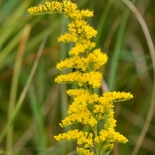
Gray Goldenrod(Solidago nemoralis)
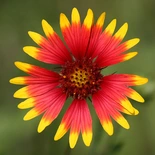
Indian Blanket(Gaillardia pulchella)
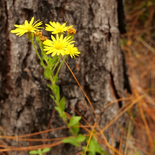
Maryland Goldenaster(Chrysopsis mariana)
“The habitat will provide nectar, pollen and shelter for a variety of native insects and birds, and will support the pollinators through their entire reproductive lifecycle with a mixture of native plants that will bloom from early spring through late fall. I’m very excited about the opportunity to use the Triangle to raise awareness in the community about the importance of native habitats to our ecosystem,” city’s Director of Planning, Building and Sustainability, Dana Hazen said.
City plants pollinator habitat at Memory Triangle-VillageLivingOnline.com
A Real Foxy Plant
Ohio: Native to most of the eastern half of the United States, foxglove beardtongue (Penstemon digitalis) is a perfect addition to the native garden, growing in clay and dry soil, sun and partial shade, and tolerant of deer and rabbit nibbling. It blooms in late spring and early summer, growing up to 30 inches tall with white, snapdragon-like flowers. The flowers ensure pollination by hairs and nectar guides that lead bees deeper into the flower.
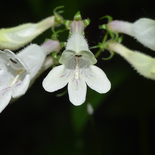
Foxglove Beardtongue(Penstemon digitalis)
Not only adaptable and attractive, this plant is also an important nectar source for a diversity of bees, butterflies and moths, and hummingbirds. It is also a host plant for the Baltimore checkerspot butterfly (Euphydryas phaeton) and the chalcedony midget moth (Elaphria chalcedonia). Birds also eat the seeds from the seedpods that form in the fall.
Native Plant: Foxglove beardtongue is a good choice for gardeners and wildlife-Dispatch.com
Predicting Ecological Tipping Points
NASA, Texas A&M AgriLife Research, and Pennsylvania State University are developing a predictive tool that could identify wetland ecological “tipping points” before they become irreversible. Wetlands play an important role in global ecology and are the most productive and valuable ecosystems on Earth, contributing to the food web, capturing carbon, and providing protective buffers against human development during hurricanes.
Using NASA’s Ocean Biology and Biogeochemistry program, which monitors short- and long-term changes on Earth, the project will be analyzing datasets, including satellite imagery and 25 years of weather data, to detect early warning signs of decline in tidal wetlands across the country. This includes identifying when tidal wetlands transition from healthy to degraded, detecting smaller and cumulative stress-signals (“micro-tipping points”) that often precede major changes, and predicting future vulnerabilities.
According to Rusty Feagin, the project’s lead author, “each year, billions of dollars go toward wetland restoration and protection. We want to help public agencies and private landowners be more strategic, investing where recovery is possible and pulling back where the damage is already done.”
Study To Forecast Ecological ‘Tipping Points’ For US Wetlands-TAMU.edu
The True Cost of Invasive Species
Since 1960, the direct global economic cost of invasive non-native plant and animal species invading new territory has cost more than $2.2 trillion and $35 billion a year, 16 times higher than initially thought, according to an international research team whose study was published in May in the journal Nature Ecology & Evolution.
Trade and travel are the leading causes of tens of thousands of animal and plant species finding and proliferating in new regions. Europe is by far the continent most affected, followed by North America and Asia. “Our study is based on only 162 species,” Ismael Soto, a scientist at the University of South Bohemia in the Czech Republic and one of the authors on the study, said. “Our figure is probably still an underestimate of a wider problem, and therefore the real economic costs could be even higher.”
When indirect costs are factored in, the United Nations’ Intergovernmental Science-Policy Platform on Biodiversity and Ecosystem Services estimates that invasive animal and plant species cost society about $400 billion a year.
The cost of some invasive species could be 16 times higher than we thought-Phys.org
Privatization of Public Land?
California: The California Native Plant Society (CNPS) has come out against the proposal to mandate the sell-off of up to 3.25 million acres in the western United States. The U.S. Senate’s Energy and Natural Resources Committee budget reconciliation package proposal names 11 western states, including California, where the sales would occur with no set limits by state.
“This proposal should outrage everyone, whether you’re a plant lover, an angler, or just someone who enjoys getting outdoors in your area. It essentially creates a backroom process with no public input, creating a massive breach of public trust. Once these places are sold, they’re gone for good–-fences go up, access disappears, and they are lost to us all forever,” ” said CNPS Conservation Program Director Nick Jensen.
California has more species of native plants and the most species at risk of extinction in the United States. In recent months, California officials from both parties have expressed strong support for protection of national monuments and other public lands.
California is targeted with up to 3.25 million acres at risk-CNPS.org