
At Wild Ones, we’re dedicated to connecting people and native plants. Our Native Plant News blog delivers the latest stories on native plant conservation, scientific discoveries, and habitat restoration from across the nation. This monthly, volunteer-written feature is designed to educate, engage, and inspire action, empowering readers to support biodiversity and promote sustainable landscaping with native flora.
Muskrat Love
Often considered pests, muskrats may be important allies in wetland preservation and increasing biodiversity, according to a study in the journal Freshwater Science.
Scientists, including those from the Sault Ste. Marie Tribe of Chippewa found that in wetland areas where muskrat lodges are found, fewer populations of non-native invasive cattails (Typha angustifolia and a hybrid of native T. latifolia and T. angustifolia: T. x glauca) and European frogbit (Hydrocharis morsus-ranae) were present. “The muskrats were creating these openings that had lower plant density. They’re reducing the invasive plant dominance around where they’re active,” Shane Lishawa, the study’s lead author, said, which leaves open spaces behind for native aquatic plants to thrive. Muskrat activity also removed dead plant material that fuels cattail invasions.
The study’s authors also attempted to replicate the effects of muskrat disturbance using underwater weed whackers and herbicides targeting non-native invasive plants. However, muskrat activity was still more effective at reducing European frogbit populations. Unfortunately, muskrat populations have been declining in North America, in some states by more than 90% since 1970, likely due to habitat loss.
New tool in fight against Great Lakes invasive species: muskrats-BridgeMI.com
Muskrat disturbances and their analogues reduce invasive plant dominance within a Great Lakes coastal wetland. Shane C. Lishawa, Andrew M. Monks, Beth A. Lawrence, Danielle L. Fegan, and Eric Clark. Freshwater Science 2025 44:2, 202-213
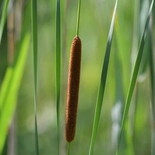
Narrowleaf Cattail(Typha angustifolia)
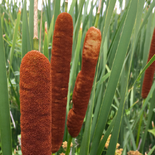
Hybrid Cattail(Typha ×glauca)
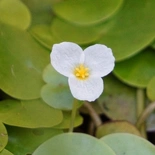
Common Frogbit(Hydrocharis morsus-ranae)
The Incredible Value of Our Ancient Grasslands
European settlers would have found that 40% of the southeastern United States would have been prairie and savannah, not forests, as once thought. As these settlers inhabited the region, most of the grasslands were converted to farmland, and many of the remaining tracts gradually turned into forests due to widespread fire-suppression policies over the last hundred years. Today, less than 5% percent of the original grasslands in the eastern United States have disappeared. The few remnants that remain are usually small, in areas difficult to farm or along roadsides and power lines where mowing prevents them from becoming forests. It’s through these remnants that we are learning the incredible value of these grassland ecosystems.
One value is the ability of these grasslands to sequester carbon. Remnant prairie in Alabama have been found to store up to 6 times more carbon underground than unburned forests. Carbon in grasslands is also stored in roots so it’s not released into the atmosphere if the plant dies. Grasslands also take less time to regenerate than forests: a degraded landscape converted to prairie can sequester as much carbon as a remnant prairie in about 8 years, found a study out of the University of Auburn. This is why grasslands “absolutely must be looked at as a major solution to carbon drawdown. We’re able to heal landscapes very quickly that have gotten off kilter, and I think that’s a very scalable model that we can apply to hundreds of thousands if not millions of acres,” said Dwayne Estes, director of the Southeastern Grasslands Institute.
Prairies also host a large amount of plant biodiversity: remnant prairies in the Southeast and Mid-Atlantic United States, on average, host 50-80 plant species per 100 square miles. Surveys by Virginia Tech identified 952 plant species in tiny remnants, representing ⅓ of all plant species in the state of Virginia. Remnant prairies attract a diversity of insect and bird populations and “are the most diverse plant systems on the continent,” according to Devin Floyd, with the Piedmont Discovery Center, who is working to identify and preserve the remnants.
Scientists have found that many of these remnant prairies could be at least 2,000 years old or even date back to the last ice age. Unfortunately, despite their value as carbon sinks and biodiversity, these remnant prairies remain at risk from agriculture, data centers, and other forms of human development.
Scientists discover an ancient landscape – in our own backyard-WashingtonPost.com
Iowa’s Got Your Goat
The Vincent Bluff Prairie, the only urban prairie preserve in the state and part of the wind-deposited silt ecosystem characteristic of the Loess Hills, is getting some help with invasive species removal from goats.
Around 100 goats are on-site, consuming up to 7% of their body weight in vegetation a day, much of it consisting of non-native invasive honeysuckle (Lonicera spp.) and bittersweet (Celastrus orbiculatus). The goats can clear an acre in about a week, depending on how much vegetation is present. By consuming invasive plants, the goats open up room for native species to re-establish. Their droppings also serve as a natural fertilizer, adding key nutrients to the soil and helping lower the carbon footprint associated with land management. The goats help maintain soil integrity, and their hooves gently aerate the soil, boosting water absorption and supporting healthier root development versus the ground compaction and erosion associated with mechanical clearing.
How goats are helping restore Iowa’s prairie and preserve the Loess Hills ecosystem-OneEarth.org
Florida: Saving the Elusive Ghost Orchid
Found only in the southwest corner of the Florida peninsula in the state with some of the most altered landscape on Earth, the ghost orchid (Dendrophylax lindenii) population has declined to fewer than 1,000 plants and less than half of those plants are mature enough to reproduce.
The ghost orchid attaches to host trees and thrives in swamp environments with standing water. It can take 15 years or more for a ghost orchid to reach reproductive maturity and bloom. Orchids that are of reproductive age flower from May to August. Under threat from poachers, hurricanes, and saltwater intrusion into the freshwater swamps it calls home, the United States Fish and Wildlife Service sided with conservation groups this June to propose that the flower be listed as an endangered species under the federal Endangered Species Act.
Despite the move to list the species, potential roadblocks lay in the way. The Trump administration has proposed a rule to redefine what it means to take a species protected under the Endangered Species Act, which excludes harm caused by habitat modifications or degradation, harm caused by people, government, or corporations. Executive orders to revoke Endangered Species Act regulations directing the Fish and Wildlife Service to review and revise critical habitat species need if it may affect the economy or national security, could also impact the ghost orchid’s listing status. Experts worry this order could be used to justify oil drilling in Big Cypress National Preserve, one of the few places the ghost orchid is found. Finally, mass firings within the federal government have impacted public land management and preservation efforts. Since January, the National Park Service has lost 24% of its permanent staff.
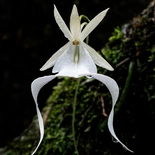
Palmpolly(Dendrophylax lindenii)
From Nuisance to Natural Insulation
Pampas grass (Cortaderia selloana), an invasive ornamental grass from South America known for aggressively spreading and negatively affecting local ecosystems, may have a positive role to play in creating sustainable housing materials.
A recent study found that pampas grass can be used as biomass insulation instead of the synthetic insulation currently used, which relies heavily on petrochemicals that cause pollution and greenhouse gas emissions. With the right processing, the insulation material from pampas grass has superior thermal efficiency and could lead to reduced heating and cooling costs and lower energy consumption in buildings using this kind of material. Growing and processing pampas grass and other species with similar properties could lead to job creation in local communities while utilizing renewable resources.
Transforming Invasive Grass into Eco-Friendly Insulation-Bioengineer.org
Cosentino, L., Ferreira, D., Fernandes, J. et al. Turning Invasive Cortaderia Selloana into Sustainable Building Insulation: A Biomass Valorization Approach. Waste Biomass Valor (2025). https://doi.org/10.1007/s12649-025-03403-z
Seed Bank Reaches 10 Million Seeds
The Native Plant Trust, the oldest plant conservation organization in the United States focusing on rare and endangered plant species that are native to New England, just hit the 10 million mark in their seed bank.
This seed bank is a flood-, bomb-, and radiation-proof vault where seeds are stored to preserve genetic diversity. “Biodiversity, that variation in species and subspecies, that’s what gives our ecosystems their functionality,” said Tim Johnson, CEO of the Native Plant Trust. “It’s what protects them from disturbances and when bad things happen, it’s what allows them to bounce back.”
Ten million rare and endangered New England seeds banked-MainePublic.org
Australia: A Pact with a Devil Bee
Megachile lucifer, a newly identified solitary bee named for the tiny devil-like horns on its head, has a taste for pollen from the critically endangered wildflower Marianthus aquilonaris found only in a small region of Western Australia. This species was described in this month’s issue of the Journal of Hymenoptera Research.
This bee may be the key to saving this endangered flower. Many plants are specialists that evolved to rely on specific pollinators. If the pollinator goes extinct, so does the plant. “Because the new species was found in the same small area as the endangered wildflower, both could be at risk from habitat disturbance and other threatening processes like climate change,” lead author of the study, Kit Prendergast, said. “Many mining companies still don’t survey for native bees, so we may be missing undescribed species, including those that play crucial roles in supporting threatened plants and ecosystems. Without knowing which native bees exist and what plants they depend on, we risk losing both before we even realise they’re there.”
Pollinators are essential to support ecosystems: more than 85% of flowering plants depend on pollinators, and losing a pollinator species causes damage throughout the entire ecosystem, from the plants they pollinate to the animals that eat those plants.
Newly Discovered “Lucifer” Bee May Be the Only Hope for a Dying Australian Plant-ZMEScience.com
Kit S. Prendergast et al, Megachile (Hackeriapis) lucifer (Hymenoptera, Megachilidae), a new megachilid with demon-like horns that visits the Critically Endangered Marianthus aquilonaris (Pittosporaceae), Journal of Hymenoptera Research (2025). DOI: 10.3897/jhr.98.166350