
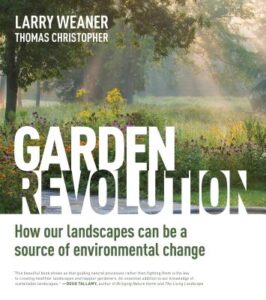
Larry Weaner and Thomas Christopher’s Garden Revolution: How Our Landscapes Can Be a Source of Environmental Change is a how-to guide for creating native landscapes, rather than what I had thought would be an analysis of how ecological gardening helps the environment. They do discuss the benefits of planting native, but this book is for people who are already convinced and want a detailed plan on how to make it happen.
This is an excerpt from the Wild Ones Journal
Current members can log in to read the latest issue or check out the Journal Archives.
Weaner provides an interesting look at his journey to becoming what he refers to as a “garden ecologist.” I identified completely with his lack of gardening experience as a child (we both had yards with mainly grass and one tree) and was surprised at how he fell into the world of landscaping by chance when he needed a summer job after high school. During the 1970s, he worked for various companies that helped him see landscaping and plants from a different perspective, and then in 1981, he started his own landscape design company. His lack of traditional design training and his exposure to radical new takes on land management helped shape his unique views on ecological garden design.
I loved the thought process behind Weaner’s approach to native gardening. First and foremost is creating a sense of discovery in the garden—allowing the garden to change and evolve rather than trying to maintain strict control. Second is what is known as “initial floristic composition”—letting what the land is predisposed to support guide you when designing your garden. And finally, using brains rather than brawn when planting and maintaining your garden.
Most of the book focuses on design and field work. This is what I found to be the most helpful, and most frustrating, part of the book. Weaner delves into analyzing your site based on the ecology, creating a plan based on what you find, and developing a customized plant list. There is so much information here that for someone new (or even someone experienced wanting to learn more), it can be overwhelming. Weaner does push starting small to not overwhelm yourself and to get used to the process, but even in that case, it still feels like you’d need outside help to figure it out.
However, I did start to feel more optimistic when going through the field portion of the book. There is some great information on preparing, planting, and managing your site, with details on different methods. It’s organized well, so I was able to focus on the processes that made the most sense for me. Additionally, Weaner provides information on creating meadows/prairies, shrublands, and woodlands, which again allows you to focus on the habitats that fit with your landscape. These sections felt more manageable, and Weaner provides many examples to help jumpstart your plans.
There is a tremendous amount of valuable information in this book, along with beautiful photographs that truly inspired me to think about my landscape in new ways. And while I can appreciate Weaner’s “brains over brawn” approach to focusing on planning so you have less work later, I think you need to be willing to just jump in and learn. This is a great guide, provided you let it inspire you rather than overwhelm you.
Vogt, M. (2023). Book review: Garden Revolution: How our landscapes can be a source of environmental change, by Larry Weaner and Thomas Christopher. Wild Ones Journal, 36(3), 33.